AEO vs SEO: What Answer Engine Optimization Changes for U.S. Businesses
· BlueHat Marketing
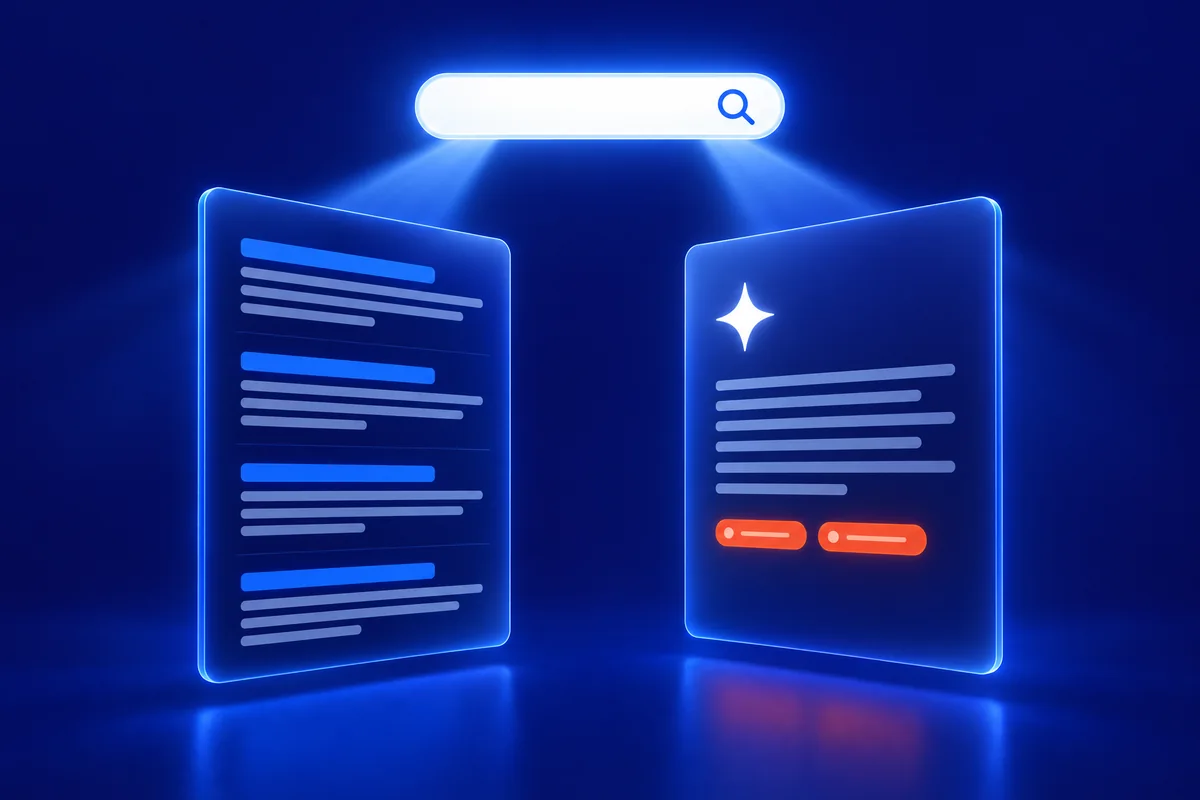
Answer engine optimization showed up in a lot of U.S. marketing plans this year, usually framed as the discipline that replaces SEO. Semrush logs about 2,900 U.S. searches a month for “what is AEO,” and much of the advice ranking for that phrase treats the two as rival camps.
Google’s own guidance for its AI features points the other way. BlueHat Marketing has worked in search since 2005 and now tracks AI answers for clients beside their rankings, so our team spends its days in both. This article puts AEO vs SEO side by side to show which parts of the work carry over and which parts are new.
What AEO Means in Plain Terms
Search engines used to hand back a list of pages and leave the reading to you. Answer engines write the reply themselves and quote a handful of sources along the way. Google AI Overviews and ChatGPT search work this way, and so do Perplexity and Microsoft Copilot.
The audience is already large. Google reported in July 2025 that AI Overviews reach more than 2 billion people a month, and OpenAI counted 900 million weekly ChatGPT users in February 2026.
Answer engine optimization, or AEO, is the work of becoming one of those quoted sources. Success means your business gets named or cited inside the answer, a different finish line from a position in a list of links.
Where AEO and SEO Share a Foundation
Most of what decides an answer engine’s sources was built for classic search first. Google’s documentation for AI features says a page must be indexed and eligible to show in Search with a snippet before it can appear as a supporting link in AI Overviews.
The same page states there are no additional requirements and no special optimizations necessary, and it tells site owners to apply the same foundational SEO practices to AI features as to Search overall. Crawlable pages and clean indexing serve both channels at once.
Authority carries over as well. Pages that earn links and mentions from trusted sites tend to rank well, and those same sites are the sources answer engines pull from when they build a reply.
Snippet settings decide what can be quoted
A setting chosen years ago can quietly block a page from being quoted. Google names the nosnippet, data-nosnippet, max-snippet and noindex controls as the way to limit what appears from a page, so a site that set max-snippet to zero has also limited what AI Overviews can lift from it.
AEO vs SEO, Side by Side
The overlap is wide, and the differences show up in four places. The table compares answer engine optimization with classic SEO on each of them.
| Classic SEO | Answer engine optimization | |
|---|---|---|
| What counts as a win | A ranking position on the results page | A mention or citation inside the generated answer |
| How content is shaped | A page built around a keyword and its search intent | Short passages that answer one question under a heading phrased like that question |
| Where results appear | The list of links below the ads | AI Overviews and assistant replies in tools such as ChatGPT and Perplexity |
| How progress is measured | Rankings and clicks in Search Console | A tracked set of questions checked for mentions each month |
Measurement is the row that changes reporting the most. Google counts traffic from its AI features inside the overall search totals in Search Console, so AI Overview clicks never get a line of their own there.
What Answer Engine Optimization Adds
Once the foundation is sound, AEO asks for two habits classic SEO did not demand.
Answer-first passages under question headings
Answer engines quote passages, so each important question deserves its own heading and a direct answer of two to four sentences right below it. Background and sales copy can follow. Pages written this way give the engine a clean block to lift, and they read faster for people too.
Question research decides which headings to write. Search demand tools show the exact phrasing people use, and Semrush data for the U.S. puts “AEO vs SEO” alone at about 1,900 searches a month.
Tracking presence inside the answers
Rank trackers report positions, which says little about AI answers. AEO adds a fixed list of buying questions, checked on a schedule, with each answer graded for a mention of your business.
Our guide on how to rank in Google AI Overviews walks through that loop for Google’s version, one step at a time.
Common Questions About AEO and SEO
What is AEO in SEO?
AEO is the part of search work aimed at getting your business quoted inside AI-generated answers. It builds on SEO, since answer engines draw on indexed pages that already rank, and it adds question-shaped content plus monthly tracking of which businesses each answer names.
Is AEO different from GEO?
The two differ only in emphasis, and most programs cover both. AEO leans toward structured answers on your own pages for answer boxes and AI Overviews. GEO, or generative engine optimization, leans toward earning citations from assistants such as ChatGPT and Perplexity across the wider web.
Do I need schema markup for AEO?
Schema markup is not required to appear in Google AI Overviews. Google states that no special schema.org structured data is needed for its AI features. Structured data still helps search engines read a page and can earn rich results, so it stays worth adding where it fits.
How long does AEO take to show results?
No fixed timeline applies, because results depend on how well your pages already rank and how crowded the answers are in your market. Tracking the same list of questions every month gives you a steady record of progress from the first check onward.
Plan AEO and SEO Together With BlueHat Marketing
Running AEO vs SEO as one program keeps a single keyword map and one set of pages working for both kinds of search. BlueHat Marketing builds that combined plan through our answer engine optimization services, and our AI SEO agency team handles the rankings it rests on.