Google AI Max + AI Overviews: Why Your Website Content Now Impacts Ads and AI Visibility
· BlueHat Marketing
Picture a plumber in Mississauga running Google Ads for drain repair. One of his ads can now send a visitor to a service page he has not touched in three years, under a headline he never wrote. Nothing is broken. With AI Max on, Google picks the page it expects to perform and writes the headline from what it finds there. BlueHat Marketing has run search ads and SEO for more than 1,800 businesses over 21 years, and the paid report and the SEO report have never overlapped the way they do now. Your website used to answer to visitors and to Google’s organic index. It now answers to your ads and to the AI engines as well, and it was never told.
Your website had one job
For twenty years a service page did two things. It convinced the person who landed on it, and it gave Google enough signal to rank. Ads lived somewhere else, in an account where the advertiser kept the last word on headlines and landing pages. A weak page cost you a ranking or a visitor, and that was the whole bill.
That arrangement ended quietly, through two settings in Google Ads and one feature at the top of the results page.
AI Max writes your ads from your pages
AI Max for Search is Google’s AI layer on search campaigns, and Google’s own help pages describe what it reads. Its text customization setting “uses text from your existing ads, landing page copy, and assets along with generative AI” to produce headlines and descriptions. Its final URL expansion setting sends traffic “to the most relevant URLs on your website when it’s likely to result in better performance,” which means Google can swap the landing page you picked for another page on your site. Its search term matching uses “landing page-based technology” to decide which searches your ad should appear for.
Read those three sentences again as a website owner. The copy on your pages is now raw material for your ads. The pages you forgot about are now candidates for your ad clicks. The searches you pay for are shaped by what your pages say. A page with two paragraphs and a phone number gives the machine two paragraphs to work with, and the ad it writes reads that way. A page with a clear offer, a service area, pricing logic and proof gives it something to sell.
You can switch each of these settings off. New Search campaigns come with AI Max turned on, and from September 2026 Google began upgrading the remaining eligible campaigns that still ran the older automation settings. Either way, the direction is set. Google is moving ad creation toward the website, and the website is where the quality has to live.
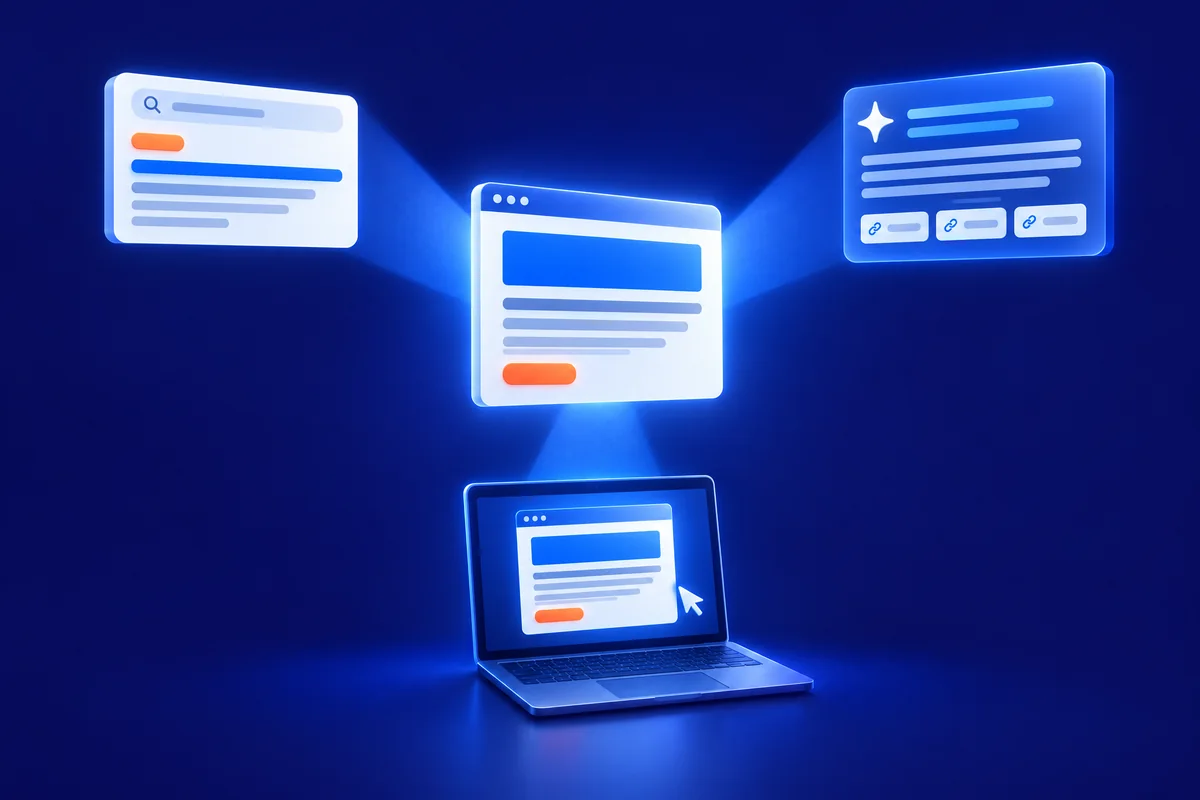
AI Overviews read the same pages to decide who to cite
At the top of the results page, the same content is being read for a different purpose. Google said in June 2026 that AI Overviews has more than 2.5 billion monthly users and that AI Mode has passed a billion. OpenAI reported 900 million weekly ChatGPT users in February 2026. Those answers are assembled from web pages, and Google has published how it chooses them.
The guidance is plainer than most of the industry chatter around it. Google states that “there are no additional requirements to appear in AI Overviews or AI Mode, nor other special optimizations necessary.” A page can be used as a source when it is “indexed and eligible to be shown in Google Search with a snippet.” The systems may use what Google calls query fan-out, “issuing multiple related searches across subtopics and data sources,” so a page that answers one narrow question well can be pulled into an answer about a bigger one. The advice that follows is the same advice that has governed rankings for years: “helpful, reliable, people-first content,” structured data that matches the visible text, and a good page experience. Google adds one line that matters for anyone counting visits: when people click through from an AI Overview, “these clicks are higher quality.”
So the service page that AI Max is reading for ad copy is the page Google’s AI is reading to decide if you exist. ChatGPT, Gemini, Perplexity and Copilot pull from the web for the same reason, each in its own way. One page, three readers, and none of them is a person yet.
Paid and organic are now the same conversation
Seer Interactive tracked 3,119 search terms across 42 client organizations from June 2024 through September 2025, on the informational queries most exposed to AI Overviews. On queries where an AI Overview appeared, paid click-through fell from 19.70 percent to 6.34 percent over that period, and organic click-through fell by 61 percent. Fewer people click anything when the answer sits at the top.
The same study found the number that changes the planning conversation. Brands cited inside the AI Overview had a 91 percent higher paid click-through rate than brands that were not, 7.89 percent against 4.14 percent on the Q3 2025 average. Seer is careful to say it cannot prove the citation causes the clicks, since brands with stronger authority are more likely to earn both. Its April 2026 follow-up, 53 brands tracked through February 2026, found the paid gap held across 2025. It also found the organic slide on those queries stopped in January and February 2026, with a warning not to read two months as a recovery. Take it as a correlation and the lesson stands. The ad and the citation now appear in the same buyer journey, and the pages are the one input you control in both.
For years the paid team and the SEO team worked on the same business without ever reading each other’s reports. They now share one input, the pages, and one outcome, the click.
Why a thin page hurts three times now
A weak service page used to cost one thing. It now costs three. The ad written from it is vague, so the click is expensive. The AI engines find nothing worth citing, so the business is absent from the answer. And the visitor who arrives anyway reads the same thin page and leaves. Unbounce’s 2024 benchmark puts the median landing page conversion rate at 6.6 percent across industries, which means a typical page already loses more than nine visitors in ten. Semrush’s 2025 study of AI search traffic estimated a visitor arriving from an AI platform is worth 4.4 times an organic visitor, so the pages that earn those visits are the last place to be thin.
None of the fixes is exotic. State the offer in the first screen, in the words a buyer uses. Name the areas you serve. Explain how pricing works even when you cannot print a price. Put proof on the page in numbers, reviews, named clients and dates, because a machine cannot infer credibility from a stock photo. Answer the questions buyers ask in full sentences, so the sentence can be quoted. Make the structured data say what the page says. Then make the page fast. Every one of those changes improves the ad and the citation at once, and the visitor who arrives reads a better page, which is the point.
Optimize the three together
This is why we stopped selling SEO and AI visibility as projects separate from conversion work, each with its own report. They act on the same pages. An SEO fix that adds a clear answer to a service page also feeds AI Max a better headline and gives ChatGPT a sentence to cite. A conversion fix that adds proof points to the page also hands the AI engines evidence they can quote. Run them apart and each team undoes the other’s work. Run them together and one edit pays three times.
Our order is simple. Audit the rankings and the technical health first, because a page that is not indexed cannot be cited, and a page Google cannot read cannot feed an ad. Audit AI visibility next, by running the real prompts your buyers ask and grading every answer. Audit conversion last, on the pages that should be selling, to see where visitors hesitate and leave. The three audits point at the same short list of pages, and that list is the work.
Three Free Audits From BlueHat Marketing
SEO gets you discovered. AI Optimization gets you understood. CRO gets the visitor to act.
BlueHat Marketing runs all three audits free, and they are yours to keep. The SEO audit covers your rankings, your technical health and Core Web Vitals. The AI visibility report shows what ChatGPT, Gemini, Perplexity and Google’s AI say about your business today, prompt by prompt. The conversion audit reads the pages that should be selling and shows where visitors leave. Ask for the three audits and we start with the page your ads are already sending people to.